
Marketplace of Claims

A complete redesign of a complex fintech marketplace to transform a fragmented experience into a transparent, efficient and trustworthy platform.
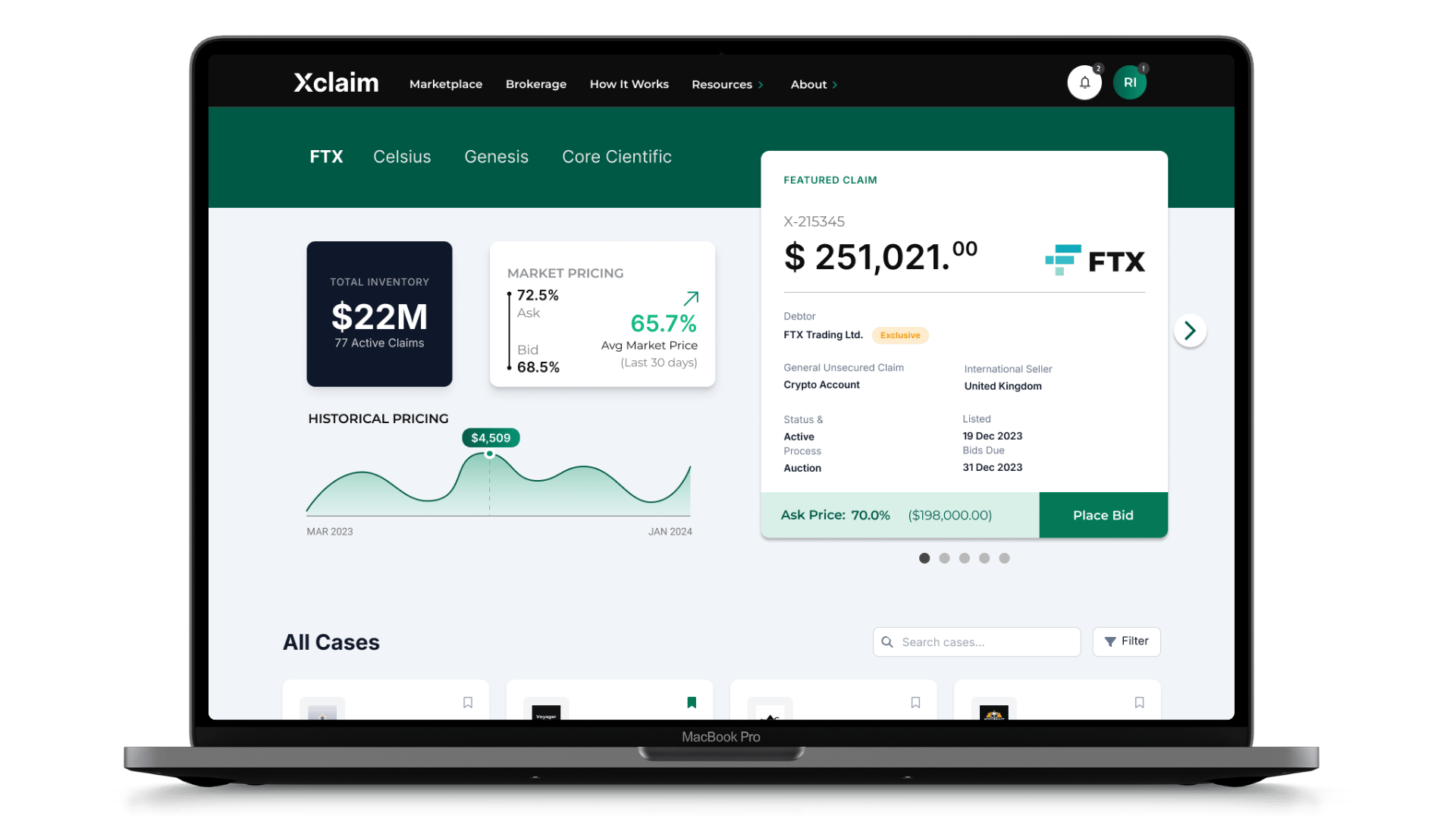

Turn Claims into Capital
List and sell effortlessly.

Trade with Confidence
Track and communicate.

Find Your Next Investment
Discover and analyze opportunities.

Manage Everything
Track portfolio and close deals.
Project Overview
The Vision for X-Claim
X-Claim is an online marketplace for buying and selling bankruptcy claims.
The original platform suffered from low transparency, inconsistent UI,
fragmented communication and high friction, reducing trust and transaction
velocity.

New dashboards for Buyers, Sellers & Admins
Communication moved inside the platform
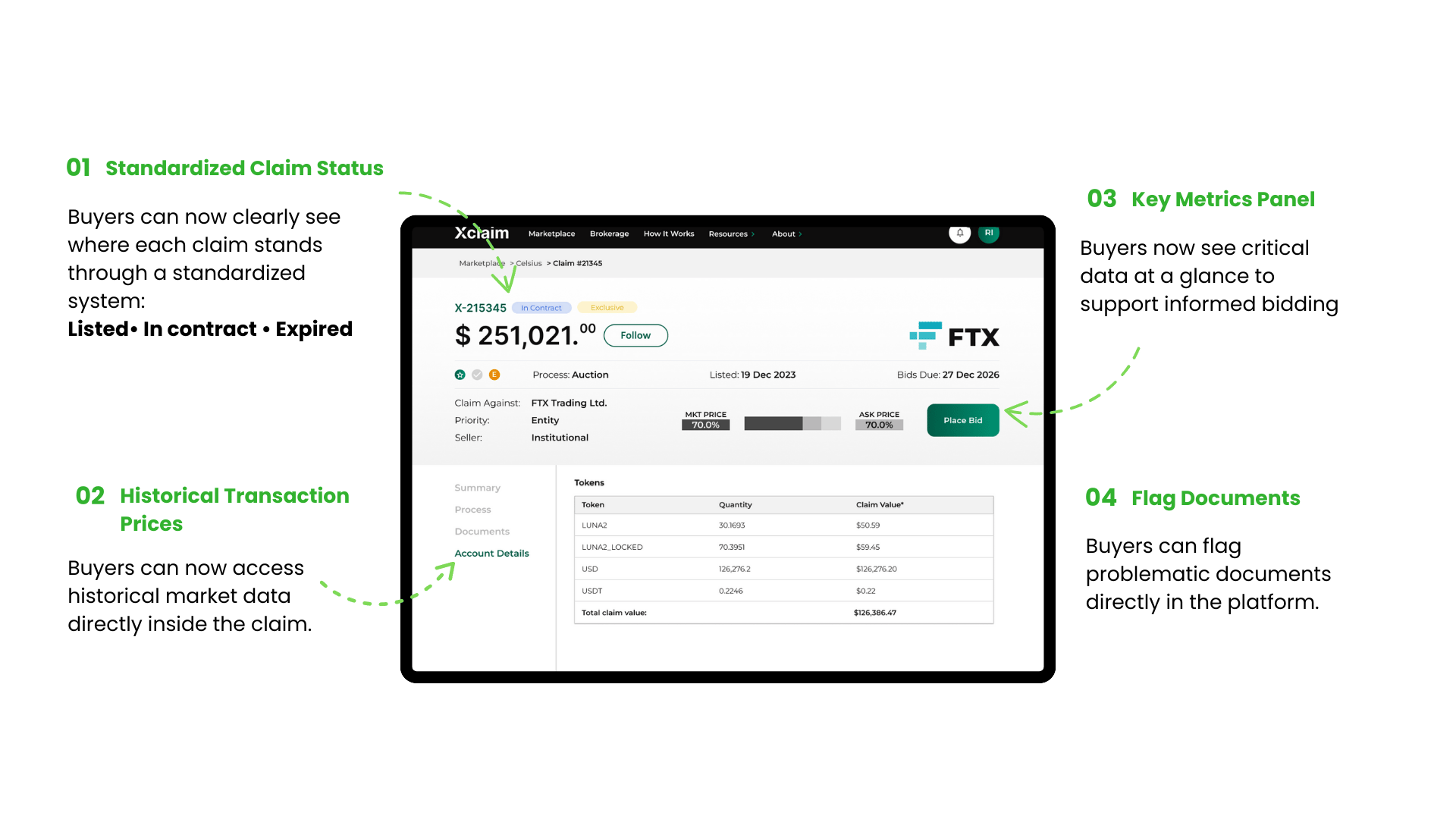
Transparent claim evaluation with historical data
My Role
Lead Product Designer
Timeline
7 months
Tools



My Design Process
A User-Centered Design Framework
I apply a user-centered, iterative process to transform complex problems into intuitive products. For the X-Claim marketplace redesign, this framework guided our 7-month journey from ambiguity to a launch-ready solution that boosted user trust and operational efficiency.
Discovery
1. Define
Align vision, define problems, success metrics, and constraints.
Deliverables:
Project Charter
Project Statement
Success Metrics
2. Research
Understand users, workflows, risks, and market dynamics.
Deliverables:
Research Insights Report
Benchmarking Matrix
Opportunity Map
Strategy
3. Analysis
Synthesize insights, prioritize problems, and align the team.
Deliverables:
Empathy Maps
User Personas
Problem Statement
4. Design
Ideate, architect solutions, test, and iterate.
Deliverables:
User Flows
Wireframes
Prototypes
5. Validation
Test with users, gather feedback, refine solutions.
Deliverables:
Usability Test Plan
Test Report
Iteration Notes
6. Refinement
Polish visuals, finalize design system, prepare handoff.
Deliverables:
Design System
Hi-Fi Mockups
UI Components
Delivery
7. Build
Collaborate with engineers, ensure accurate implementation.
Deliverables:
Dev-Ready Files
Interaction Specs
Handoff Package
8. Iteration & Launch
Optimize the experience and support a successful product release.
Deliverables:
Optimized UI
Bug Reports & Fixes
Launch Assets
Phase 01
Discovery Phase
Establishing a shared understanding of the problem to ensure alignment between
business goals, user needs, and product constraints.

Step 1
Define: The Foundation of Success
Although my role was UX/UI Designer, the project required a product-driven approach, where problem framing, scope definition, and strategic alignment were essential before design execution.

Client Problem (Initial Input)
X-Claim needed to improve the efficiency
and trust of their bankruptcy claims
marketplace. Buyers and sellers faced
friction in bidding, communication, and
transactions, limiting platform growth and
user autonomy.
1

2
From Client to Design Problem
We reframed business challenges into a
design problem focused on user behavior,
decision-making, and system trust.
Design Problem Statement:
How might we enable users to evaluate, communicate, and transact claims efficiently and transparently, while reducing dependency on manual intervention?

Project Objectives (Initial
Hypotheses)

Increase transparency in claim
evaluation.
Improve buyer and seller autonomy.
Reduce friction from manual processes.
Enable scalability without increasing
operational load.
3



Analytics & Platform Audit: The "What" and "Where"
Data revealed strong user intent to trade, yet many transactions were abandoned or managed off-platform using emails and spreadsheets.

Heuristic Evaluation: The Usability Breakdown
A usability review exposed key issues: inconsistent controls, lack of system feedback, and high cognitive load caused by fragmented information architecture.

User Interviews: Uncovering the “Why”
I conducted 12 moderated interviews (6 buyers, 6 sellers) to understand user psychology, workflows, and unmet needs in this high-stakes financial context.
Step 2
Research: Validating the problem space
The initial hypothesis was clear: the platform’s experience was fragmented. To move from assumption to evidence, I led a 7-week research phase combining quantitative analysis, heuristic evaluation, and direct user engagement to uncover the “why” behind the friction.
Phase 02
Strategy Phase
Establishing a shared understanding of the problem to ensure alignment between
business goals, user needs, and product constraints.
Step 1
Synthesizing Research into Human Faces
Research revealed two distinct archetypes of users with opposing needs in the same marketplace: the Creditor needing liquidity and the Investor seeking value. Creating these personas allowed us to move from abstract data to empathetic, human-centered design targets, ensuring every feature solved a real problem for a real person.
Alyssa
Former FinTech Employee
About Me
I'm navigating a tough financial situation after my crypto employer's collapse. I'm not an investor, just someone who needs to turn a complex legal claim into cash quickly and safely.
Needs
1
A straightforward way to list my claim without confusing legal terms or complex forms.
2
Confidence that the buyers are verified and the transaction is secure from start to finish.
3
A central dashboard to see all my listings, track offers, and understand my claim's status at a glance.
What likes the most
1
I appreciated the personal support and guidance from the team when I felt lost.
2
Knowing my claim was exposed to a large pool of serious investors gave me hope for a good offer.
3
The idea of having all claim information in one organized place seemed very promising and modern.
Frustrations
1
After submitting my claim on the old site, I was sent to the homepage with no way to log back in or see what happened next.
2
I'm anxious about fraud and dealing with unknown, unverified buyers in a high-stakes process.
3
It feels like the real action happens behind the scenes in emails, where I have no control or record.
Edward
Hedge Fund Founder
About Me
I run a fund focused on distressed assets. My edge is spotting undervalued claims in complex bankruptcies faster and more accurately than my competition.
Needs
1
Instant access to all bankruptcy documents, seller history, and detailed asset breakdowns for risk assessment.
2
Advanced filters, saved searches, and bulk bidding to manage and act on hundreds of opportunities efficiently.
3
Historical price data and market activity insights to benchmark my bids and understand valuation trends.
What likes the most
1
The primary reason I use X-Claim is the sheer volume and variety of claims available on the platform.
2
The ability to review a claim and place a bid quickly is a core strength of the current system.
3
Having a centralized, structured feed of claim information saves me time compared to other sources.
Frustrations
1
Too many claims on the old platform lacked critical documentation, forcing me to do external research and guesswork.
2
No central dashboard to track all my bids, and no way to bid on multiple claims at once—a huge waste of time.
3
No visibility into market activity or competing interest, making it hard to gauge why bids succeeded or failed.


Step 2
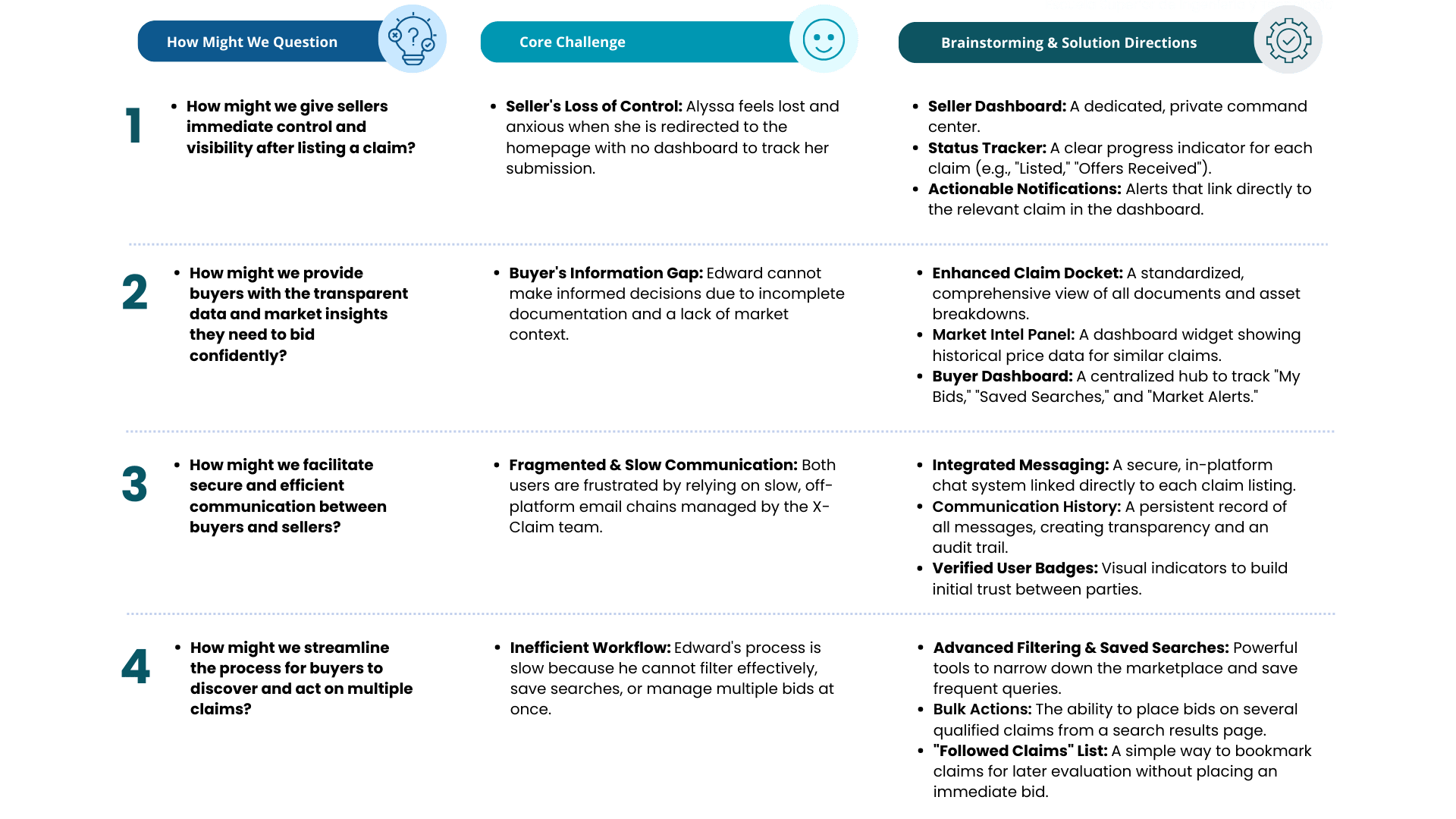
How Might We
This framework transforms key user frustrations into actionable design opportunities. Through these questions, we guided our brainstorming and solution ideation for the X-Claim redesign.
Phase 03
Design Phase
Translating insights into high-quality design solutions that balance user needs, business goals, and technical feasibility, iterating through prototypes and visual design to create a cohesive, scalable, and intuitive product experience.
Claim view Before
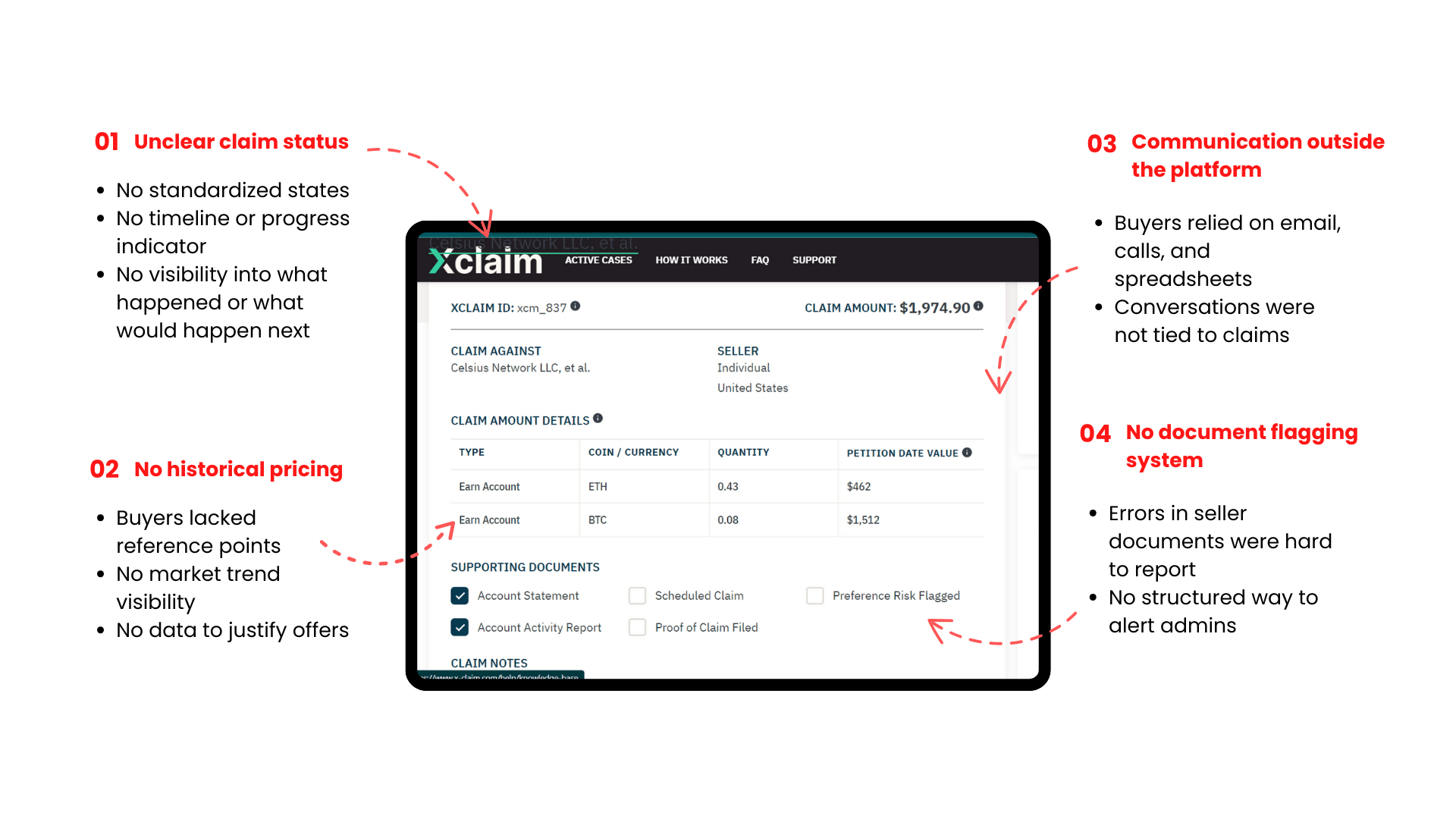
Claim view After
Next Project?
Erika Kishishita
Product Designer
Home
Projects
Let's Create
Something
Amazing Together
I'm always open to discussing new projects, creative ideas, or opportunities to be part of your visions.


erikakishishita@gmail.com


Marketplace of Claims
A complete redesign of a complex fintech marketplace to transform a fragmented experience into a transparent, efficient and trustworthy platform.

Turn Claims into Capital
List and sell effortlessly.

Trade with Confidence
Track and communicate.

Find Your Next Investment
Discover and analyze opportunities.

Manage Everything
Track portfolio and close deals.
Project Overview
The Vision for X-Claim
X-Claim is an online marketplace for buying and selling bankruptcy claims.
The original platform suffered from low transparency, inconsistent UI,
fragmented communication and high friction, reducing trust and transaction
velocity.
New dashboards for Buyers, Sellers & Admins
Communication moved inside the platform
Transparent claim evaluation with historical data
My Role
Lead Product Designer
Timeline
7 months
Tools
My Design Process
A User-Centered Design Framework
I apply a user-centered, iterative process to transform complex problems into intuitive products. For the X-Claim marketplace redesign, this framework guided our 7-month journey from ambiguity to a launch-ready solution that boosted user trust and operational efficiency.
Discovery
1. Define
Align vision, define problems, success metrics, and constraints.
Deliverables:
Project Charter
Project Statement
Success Metrics
2. Research
Understand users, workflows, risks, and market dynamics.
Deliverables:
Research Insights Report
Benchmarking Matrix
Opportunity Map
Strategy
3. Analysis
Synthesize insights, prioritize problems, and align the team.
Deliverables:
Empathy Maps
User Personas
Problem Statement
4. Design
Ideate, architect solutions, test, and iterate.
Deliverables:
User Flows
Wireframes
Prototypes
5. Validation
Test with users, gather feedback, refine solutions.
Deliverables:
Usability Test Plan
Test Report
Iteration Notes
6. Refinement
Polish visuals, finalize design system, prepare handoff.
Deliverables:
Design System
Hi-Fi Mockups
UI Components
Delivery
7. Build
Collaborate with engineers, ensure accurate implementation.
Deliverables:
Dev-Ready Files
Interaction Specs
Handoff Package
8. Iteration & Launch
Optimize the experience and support a successful product release.
Deliverables:
Optimized UI
Bug Reports & Fixes
Launch Assets
Phase 01
Discovery Phase
Establishing a shared understanding of the problem to ensure alignment between
business goals, user needs, and product constraints.
Step 1
Define: The Foundation of Success
Although my role was UX/UI Designer, the project required a product-driven approach, where problem framing, scope definition, and strategic alignment were essential before design execution.
Client Problem (Initial Input)
X-Claim needed to improve the efficiency
and trust of their bankruptcy claims
marketplace. Buyers and sellers faced
friction in bidding, communication, and
transactions, limiting platform growth and
user autonomy.
1
2
From Client to Design Problem
We reframed business challenges into a
design problem focused on user behavior,
decision-making, and system trust.
Design Problem Statement:
How might we enable users to evaluate, communicate, and transact claims efficiently and transparently, while reducing dependency on manual intervention?
Project Objectives (Initial
Hypotheses)
Increase transparency in claim
evaluation.
Improve buyer and seller autonomy.
Reduce friction from manual processes.
Enable scalability without increasing
operational load.
3
Analytics & Platform Audit: The "What" and "Where"
Data revealed strong user intent to trade, yet many transactions were abandoned or managed off-platform using emails and spreadsheets.
Heuristic Evaluation: The Usability Breakdown
A usability review exposed key issues: inconsistent controls, lack of system feedback, and high cognitive load caused by fragmented information architecture.
User Interviews: Uncovering the “Why”
I conducted 12 moderated interviews (6 buyers, 6 sellers) to understand user psychology, workflows, and unmet needs in this high-stakes financial context.
Step 2
Research: Validating the problem space
The initial hypothesis was clear: the platform’s experience was fragmented. To move from assumption to evidence, I led a 7-week research phase combining quantitative analysis, heuristic evaluation, and direct user engagement to uncover the “why” behind the friction.
Phase 02
Strategy Phase
Establishing a shared understanding of the problem to ensure alignment between
business goals, user needs, and product constraints.
Step 1
Synthesizing Research into Human Faces
Research revealed two distinct archetypes of users with opposing needs in the same marketplace: the Creditor needing liquidity and the Investor seeking value. Creating these personas allowed us to move from abstract data to empathetic, human-centered design targets, ensuring every feature solved a real problem for a real person.
Alyssa
Former FinTech Employee
About Me
I'm navigating a tough financial situation after my crypto employer's collapse. I'm not an investor, just someone who needs to turn a complex legal claim into cash quickly and safely.
Needs
1
A straightforward way to list my claim without confusing legal terms or complex forms.
2
Confidence that the buyers are verified and the transaction is secure from start to finish.
3
A central dashboard to see all my listings, track offers, and understand my claim's status at a glance.
What likes the most
1
I appreciated the personal support and guidance from the team when I felt lost.
2
Knowing my claim was exposed to a large pool of serious investors gave me hope for a good offer.
3
The idea of having all claim information in one organized place seemed very promising and modern.
Frustrations
1
After submitting my claim on the old site, I was sent to the homepage with no way to log back in or see what happened next.
2
I'm anxious about fraud and dealing with unknown, unverified buyers in a high-stakes process.
3
It feels like the real action happens behind the scenes in emails, where I have no control or record.
Edward
Hedge Fund Founder
About Me
I run a fund focused on distressed assets. My edge is spotting undervalued claims in complex bankruptcies faster and more accurately than my competition.
Needs
1
Instant access to all bankruptcy documents, seller history, and detailed asset breakdowns for risk assessment.
2
Advanced filters, saved searches, and bulk bidding to manage and act on hundreds of opportunities efficiently.
3
Historical price data and market activity insights to benchmark my bids and understand valuation trends.
What likes the most
1
The primary reason I use X-Claim is the sheer volume and variety of claims available on the platform.
2
The ability to review a claim and place a bid quickly is a core strength of the current system.
3
Having a centralized, structured feed of claim information saves me time compared to other sources.
Frustrations
1
Too many claims on the old platform lacked critical documentation, forcing me to do external research and guesswork.
2
No central dashboard to track all my bids, and no way to bid on multiple claims at once—a huge waste of time.
3
No visibility into market activity or competing interest, making it hard to gauge why bids succeeded or failed.
Step 2
How Might We
This framework transforms key user frustrations into actionable design opportunities. Through these questions, we guided our brainstorming and solution ideation for the X-Claim redesign.
Phase 03
Design Phase
Translating insights into high-quality design solutions that balance user needs, business goals, and technical feasibility, iterating through prototypes and visual design to create a cohesive, scalable, and intuitive product experience.
Claim view Before
Claim view After
Let's Create Something
Amazing Together
I'm always open to discussing new projects, creative ideas, or opportunities to be part of your visions.

erikakishishita@gmail.com
Next Project?
Marketplace of Claims

A complete redesign of a complex fintech marketplace to transform a fragmented experience into a transparent, efficient and trustworthy platform.

Turn Claims into Capital
List and sell effortlessly.

Trade with Confidence
Track and communicate.

Find Your Next Investment
Discover and analyze opportunities.

Manage Everything
Track portfolio and close deals.
Project Overview
The Vision for X-Claim
X-Claim is an online marketplace for buying and selling bankruptcy claims.
The original platform suffered from low transparency, inconsistent UI,
fragmented communication and high friction, reducing trust and transaction
velocity.
New dashboards for Buyers, Sellers & Admins
Communication moved inside the platform
Transparent claim evaluation with historical data
My Role
Lead Product Designer
Timeline
7 months
Tools
My Design Process
A User-Centered Design Framework
I apply a user-centered, iterative process to transform complex problems into intuitive products. For the X-Claim marketplace redesign, this framework guided our 7-month journey from ambiguity to a launch-ready solution that boosted user trust and operational efficiency.
Discovery
1. Define
Align vision, define
problems, success
metrics, and constraints.
Deliverables:
Project Charter
Project Statement
Success Metrics
2. Research
Understand users,
workflows, risks, and
market dynamics.
Deliverables:
Research Insights Report
Benchmarking Matrix
Opportunity Map
Strategy
3. Analysis
Convert research
findings into strategic
clarity and actionable
insights.
Deliverables:
Personas & User Journeys
Pain Point Matrix
Strategic UX Priorities
4. Ideation
Collaboratively explore a
wide range of potential
solutions.
Deliverables:
Concept Sketches
Information Architecture
Prioritized Concepts
Design
5. Design
Transform concepts into
high-quality, scalable
product experiences.
Deliverables:
High-Fidelity Screens
Design System
Interactive Prototypes
Validation
6. Testing
Validate usability, clarity,
and value with real
users.
Deliverables:
Usability Test Report
Validated Prototype
Recommendations
Delivery
7. Specifications
Enable accurate, predictable
implementation by the
development team.
Deliverables:
Annotated Screens
Interaction Specs
Handoff Package
8. Iteration &
Launch
Optimize the experience
and support a successful
product release.
Deliverables:
Optimized UI
Bug Reports & Fixes
Launch Assets
Phase 01
Discovery Phase
Establishing a shared understanding of the problem to ensure alignment between
business goals, user needs, and product constraints.
Step 1
Define: The Foundation of Success
Although my role was UX/UI Designer, the project required a product-driven approach, where problem framing, scope definition, and strategic alignment were
essential before design execution.

Client Problem (Initial Input)
X-Claim needed to improve the efficiency
and trust of their bankruptcy claims
marketplace. Buyers and sellers faced
friction in bidding, communication, and
transactions, limiting platform growth and
user autonomy.
1
2
From Client to Design Problem
We reframed business challenges into a
design problem focused on user behavior,
decision-making, and system trust.
Design Problem Statement:
How might we enable users to evaluate,
communicate, and transact claims efficiently
and transparently, while reducing
dependency on manual intervention?
Project Objectives (Initial
Hypotheses)
Increase transparency in claim
evaluation.
Improve buyer and seller autonomy.
Reduce friction from manual processes.
Enable scalability without increasing
operational load.
3
Step 2
Research: Validating the problem space
The initial hypothesis was clear: the platform’s experience was fragmented. To move from assumption to evidence, I led a 7-week research phase combining quantitative analysis, heuristic evaluation, and direct user engagement to uncover the “why” behind the friction.
Analytics & Platform Audit: The "What" and "Where"
Data revealed strong user intent to trade, yet many transactions were abandoned or managed off-platform using emails and spreadsheets.
Heuristic Evaluation: The Usability Breakdown
A usability review exposed key issues: inconsistent controls, lack of system feedback, and high cognitive load caused by fragmented information architecture.
User Interviews: Uncovering the “Why”
I conducted 12 moderated interviews (6 buyers, 6 sellers) to understand user psychology, workflows, and unmet needs in this high-stakes financial context.
Phase 02
Strategy Phase
Establishing a shared understanding of the problem to ensure alignment between
business goals, user needs, and product constraints.
Step 1
Synthesizing Research into Human Faces
Research revealed two distinct archetypes of users with opposing needs in the same marketplace: the Creditor needing liquidity and the Investor seeking value. Creating these personas allowed us to move from abstract data to empathetic, human-centered design targets, ensuring every feature solved a real problem for a real person.
Alyssa
Former FinTech Employee
About Me
I'm navigating a tough financial situation after my crypto employer's collapse. I'm not an investor, just someone who needs to turn a complex legal claim into cash quickly and safely.
Needs
1
A straightforward way to list my claim without confusing legal terms or complex forms.
2
Confidence that the buyers are verified and the transaction is secure from start to finish.
3
A central dashboard to see all my listings, track offers, and understand my claim's status at a glance.
What likes the most
1
I appreciated the personal support and guidance from the team when I felt lost.
2
Knowing my claim was exposed to a large pool of serious investors gave me hope for a good offer.
3
The idea of having all claim information in one organized place seemed very promising and modern.
Frustrations
1
After submitting my claim on the old site, I was sent to the homepage with no way to log back in or see what happened next.
2
I'm anxious about fraud and dealing with unknown, unverified buyers in a high-stakes process.
3
It feels like the real action happens behind the scenes in emails, where I have no control or record.
#Simplicity
#Finance
#Legal
#Security

Edward
Hedge Fund Founder
About Me
I run a fund focused on distressed assets. My edge is spotting undervalued claims in complex bankruptcies faster and more accurately than my competition.
Needs
1
Instant access to all bankruptcy documents, seller history, and detailed asset breakdowns for risk assessment.
2
Advanced filters, saved searches, and bulk bidding to manage and act on hundreds of opportunities efficiently.
3
Historical price data and market activity insights to benchmark my bids and understand valuation trends.
What likes the most
1
The primary reason I use X-Claim is the sheer volume and variety of claims available on the platform.
2
The ability to review a claim and place a bid quickly is a core strength of the current system.
3
Having a centralized, structured feed of claim information saves me time compared to other sources.
Frustrations
1
Too many claims on the old platform lacked critical documentation, forcing me to do external research and guesswork.
2
No central dashboard to track all my bids, and no way to bid on multiple claims at once—a huge waste of time.
3
No visibility into market activity or competing interest, making it hard to gauge why bids succeeded or failed.
#Data
#Efficiency
#Analysis
#Deals
Step 2
How Might We
This framework transforms key user frustrations into actionable design opportunities. Through these questions, we guided our brainstorming and solution ideation for the X-Claim redesign.
Phase 03
Design Phase
Translating insights into high-quality design solutions that balance user needs, business goals, and technical feasibility, iterating through prototypes and visual design to create a cohesive, scalable, and intuitive product experience.
Claim view Before
Claim view After
Let's create something together
I'm always excited to work on new projects and collaborate with talented teams. Let's chat!

erikakishishita@gmail.com

Next Project?